


Page 15 - Economic report 2020
P. 15
Accumulated savings, the dynamic            The inflationary process and consequent rise
                     labour market and international          in interest rates around the world resulted in
                        trade sustained the economy.          a slowdown in economic activity in 2022. The
                                                              falling  purchasing  power  of  wages,  caused
                                                              by  inflation,  together  with  more  expensive
                     credit  due  to  the  contractionary  monetary  policies,  slowed  growth  in  household  consumption
                     and business investment. But the dynamic labour market and accumulated household savings,
                     especially those with medium and high incomes, in the years of the pandemic (2020 and 2021),
                     partly offset the impact of inflation and kept growth in internal demand positive. To this was
                     added the good performance of the global trade in goods (+5.2%) and the recovery in tourism
                     flows, which especially benefited economies with a major bias in the tourism sector, such as the
                     Spanish economy.

                     One of the factors explaining why the economy resisted the onslaught of inflationary pressures
                     better than expected in 2002 are the economic policy measures adopted to combat the effects
                     of the pandemic that were still in place, combined with the aid approved by countries to offset the
                     impact of surging inflation. Within Europe, the European Commission extended the temporary
                     easing  of  the  EU  Stability  and  Growth  Pact  fiscal  rules  in  2022,  allowing  members  states  to
                     take  on  debt  without  restrictions.  Moreover,  the  European  Commission  authorised  the  first
                     packages of NextGenerationEU funds for member states, containing 806,900 million euros  for
                                                                                                1
                     the 2021-2027 period and representing the first European fiscal instrument financed by joint
                     European debt. The aim of these funds is to stimulate environmental sustainability, promote the
                     digital  transformation and mitigate the economic and social impact of the pandemic. Added to
                     these  European-based  measures  are  those
                     that were introduced by members states    Measures to combat the effects of the             13
                     which  focus  on  reducing  the  effect  of  rising   Covid-19 pandemic and inflation
                     energy costs on households and businesses
                     (tax breaks, transport discounts and direct aid   contributed to economic recovery in 2022.
                     to the most affected groups, among others).
                     All  these  initiatives  have  played  in  favour  of
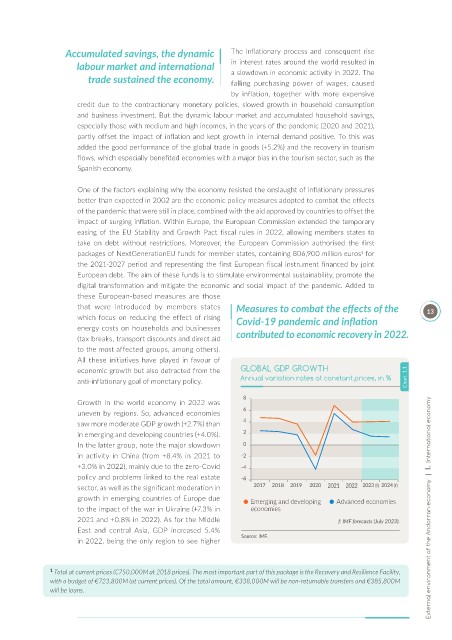
                     economic growth but also detracted from the   GLOBAL GDP GROWTH
                     anti-inflationary goal of monetary policy.  Annual variation rates at constant prices, in %  Chart  1.1

                     Growth  in  the  world  economy  in  2022  was
                     uneven by regions. So, advanced economies
                     saw more moderate GDP growth (+2.7%) than
                     in emerging and developing countries (+4.0%).
                     In the latter group, note the major slowdown
                     in  activity  in  China  (from  +8.4%  in  2021  to
                     +3.0% in 2022), mainly due to the zero-Covid
                     policy and problems linked to the real estate
                     sector, as well as the significant moderation in
                     growth in emerging countries of Europe due    Emerging and developing   Advanced economies
                     to the impact of the war in Ukraine (+7.3% in   economies                                    External environment of the Andorran economy  |  I.  International economy
                     2021 and +0.8% in 2022). As for the Middle                           f: IMF forecasts (July 2023).
                     East  and  central  Asia,  GDP  increased  5.4%
                     in 2022, being the only region to see higher   Source: IMF.


              1  Total at current prices (€750,000M at 2018 prices). The most important part of this package is the Recovery and Resilience Facility,
              with a budget of €723,800M (at current prices). Of the total amount, €338,000M will be non-returnable transfers and €385,800M
              will be loans.

