


Page 16 - Economic report 2020
P. 16
growth than in the previous year (+4.4%). The   The slowdown in the Chinese economy
                     reason is the upward trend in oil prices, which   limits the growth of emerging economies.
                     has benefited oil-exporting countries such as
                     Saudi Arabia, Iraq and Iran. Finally, the block
                     of Latin America and the Caribbean saw growth of 3.9% which, despite being lower than the
                     7.0% of the previous year, is considered to be a relatively positive rate, thanks to the good trend
                     in prices of commodities, of which it is a major exporter.


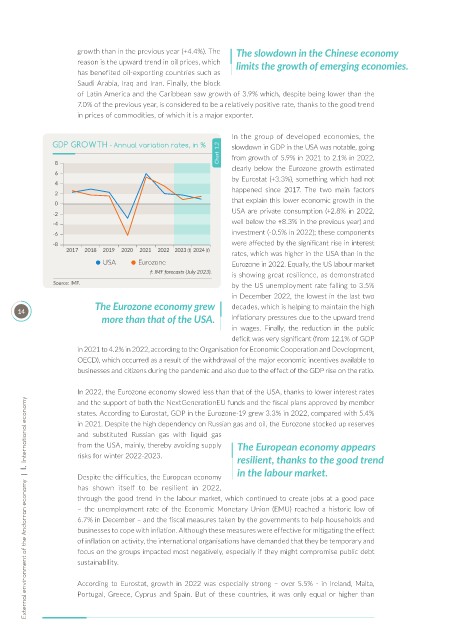
                                                              In the group of developed economies, the
               GDP GROWTH - Annual variation rates, in %      slowdown in GDP in the USA was notable, going
                                                           Chart  1.2   from growth of 5.9% in 2021 to 2.1% in 2022,

                                                              clearly  below  the  Eurozone  growth  estimated
                                                              by Eurostat (+3.3%), something which had not
                                                              happened  since  2017.  The  two  main  factors
                                                              that explain this lower economic growth in the
                                                              USA are private consumption (+2.8% in 2022,
                                                              well below the +8.3% in the previous year) and
                                                              investment (-0.5% in 2022); these components
                                                              were affected by the significant rise in interest
                                                              rates, which was higher in the USA than in the
                            USA      Eurozone                 Eurozone in 2022. Equally, the US labour market
                                         f: IMF forecasts (July 2023).  is showing great resilience, as demonstrated
               Source: IMF.                                   by the US unemployment rate falling to 3.5%
                                                              in December 2022, the lowest in the last two
                          The Eurozone economy grew           decades, which is helping to maintain the high
      14
                            more than that of the USA.        inflationary pressures due to the upward trend
                                                              in  wages.  Finally,  the  reduction  in  the  public
                                                              deficit was very significant (from 12.1% of GDP
                     in 2021 to 4.2% in 2022, according to the Organisation for Economic Cooperation and Development,
                     OECD), which occurred as a result of the withdrawal of the major economic incentives available to
                     businesses and citizens during the pandemic and also due to the effect of the GDP rise on the ratio.


                     In 2022, the Eurozone economy slowed less than that of the USA, thanks to lower interest rates
        External environment of the Andorran economy  |  I.  International economy
                     and the support of both the NextGenerationEU funds and the fiscal plans approved by member
                     states. According to Eurostat, GDP in the Eurozone-19 grew 3.3% in 2022, compared with 5.4%
                     in 2021. Despite the high dependency on Russian gas and oil, the Eurozone stocked up reserves
                     and  substituted  Russian  gas  with  liquid  gas
                     from the USA, mainly, thereby avoiding supply   The European economy appears
                     risks for winter 2022-2023.                resilient, thanks to the good trend
                                                                in the labour market.
                     Despite the difficulties, the European economy
                     has  shown  itself  to  be  resilient  in  2022,
                     through the good trend in the labour market, which continued to create jobs at a good pace
                     – the unemployment rate of the Economic Monetary Union (EMU) reached a historic low of
                     6.7% in December – and the fiscal measures taken by the governments to help households and
                     businesses to cope with inflation. Although these measures were effective for mitigating the effect
                     of inflation on activity, the international organisations have demanded that they be temporary and
                     focus on the groups impacted most negatively, especially if they might compromise public debt
                     sustainability.

                     According to Eurostat, growth in 2022 was especially strong – over 5.5% - in Ireland, Malta,
                     Portugal, Greece, Cyprus and Spain. But of these countries, it was only equal or higher than

