


Page 81 - Economic report 2020
P. 81
pandemic. Remember that the tobacco harvest in 2019 was almost 245,000 kg, whereas the figure
                     fell to 119,831 kg in 2022. The 2022 harvest was affected by fungus and bad weather.


                     The  customs  integration  process  agreed  by  Andorra  with  the  European  Union  establishes  a
                     30-year transition period for the tobacco sector before inclusion in the Customs Union, from
                     entry into force of the Association Agreement. From the seventh year, Andorra would have to
                     start gradually waiving the current customs duties while adopting the EU acquis at the same
                     time, with the final goal of completely removing customs duties. In exchange for approval of the
                     preferential treatment period, Andorra must demonstrate that it is diversifying its economy to
                     reduce its economic dependence on tobacco; that it is combatting fraud and smuggling, and that it
                     undertakes not to increase the tobacco price differential between the EU and Andorra, especially
                     with its neighbouring states.

                     As for apiaries, in 2022 there were 43, five less than in the previous year, with a total of 543
                     hives, 15 more than in 2021. This means that there are less apiaries but they are larger. Of these
                     apiaries, 24 are dedicated exclusively to beekeeping while 19 practise apiculture as a side-line.

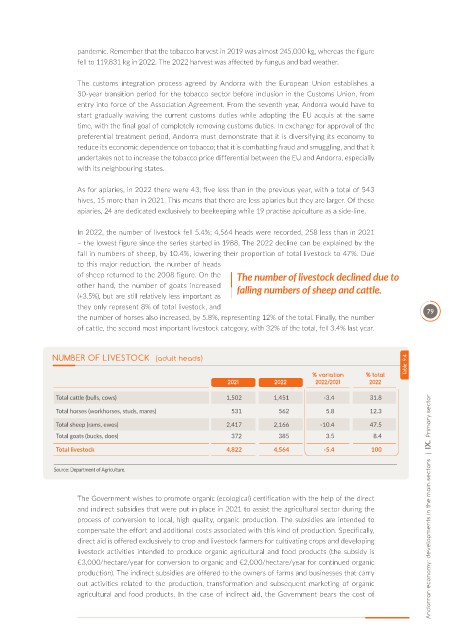
                     In 2022, the number of livestock fell 5.4%; 4,564 heads were recorded, 258 less than in 2021
                     – the lowest figure since the series started in 1988. The 2022 decline can be explained by the
                     fall in numbers of sheep, by 10.4%, lowering their proportion of total livestock to 47%. Due
                     to this major reduction, the number of heads
                     of sheep returned to the 2008 figure. On the   The number of livestock declined due to
                     other hand, the number of goats increased   falling numbers of sheep and cattle.
                     (+3.5%), but are still relatively less important as
                     they only represent 8% of total livestock, and                                              79
                     the number of horses also increased, by 5.8%, representing 12% of the total. Finally, the number
                     of cattle, the second most important livestock category, with 32% of the total, fell 3.4% last year.


               NUMBER OF LIVESTOCK  (adult heads)                                                           Table  9.4

                                                                                   % variation   % total
                                                             2021        2022       2022/2021     2022

                Total cattle (bulls, cows)                   1,502       1,451        -3.4        31.8
                Total horses (workhorses, studs, mares)       531         562          5.8        12.3
                Total sheep (rams, ewes)                     2,417       2,166       -10.4        47.5
                Total goats (bucks, does)                     372         385          3.5         8.4
                Total livestock                              4,822       4,564        -5.4         100


               Source: Department of Agriculture.


                     The Government wishes to promote organic (ecological) certification with the help of the direct
                     and indirect subsidies that were put in place in 2021 to assist the agricultural sector during the   Andorran economy: developments in the main sectors  |  IX.  Primary sector
                     process of conversion to local, high quality, organic production. The subsidies are intended to
                     compensate the effort and additional costs associated with this kind of production. Specifically,
                     direct aid is offered exclusively to crop and livestock farmers for cultivating crops and developing
                     livestock activities intended to produce organic agricultural and food products (the subsidy is
                     €3,000/hectare/year for conversion to organic and €2,000/hectare/year for continued organic
                     production). The indirect subsidies are offered to the owners of farms and businesses that carry
                     out  activities  related  to  the  production,  transformation  and  subsequent  marketing  of  organic
                     agricultural and food products. In the case of indirect aid, the Government bears the cost of

