


Page 87 - Economic report 2020
P. 87
In contrast, if we consider the trend in industrial production, the improvement in activity is modest.
                     So, businesses indicated an upward trend in volumes of production in the second half of 2022,
                     but at a more moderate rate than in the same period of 2021, affected by rising production
                     costs, problems in the global supply chains – despite these waning – and weakening of the main
                     neighbouring economies.

                     In parallel, the average productive capacity utilisation continued to recover and reached 72.8%
                     in the second half of 2022, a value that already puts it above the levels prior to the health crisis
                     (70.5% on average in the period 2017-2019). However, this is still far from the historic highs of
                     the series (around 77%).


                     Finally, sales prices pursued an upward trend, due to rising costs (mainly prices of energy and
                     raw materials), while in the labour market, employment saw a positive trend throughout the year.

                     Of the factors limiting progress in business activity in the second half of 2022, the main obstacle is
                     the rising cost of supplies and materials, with 74% of industries indicating this. Moreover, note the
                     growing concern about operating costs, which has reached a record level (54% of the total), ahead
                     of other factors such as the shortage of qualified workers and weak demand – both mentioned by
                     38% of those surveyed. Finally, note that supply problems, stock shortages, transport problems
                     and its rising cost are still notable challenges for a significant number of industries, despite falling
                     in importance since the first half of the year.

                     The business forecasts for the first half of 2023 confirm a continued recovery in the industrial
                     sector but at a slower rate than expected a few months ago and also more moderate than in the
                     three previous half years.
                                                                                                                 85


              XI.      Construction and related industries


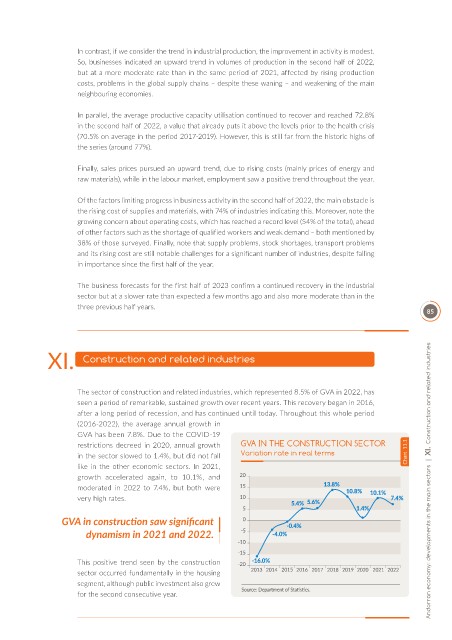
                     The sector of construction and related industries, which represented 8.5% of GVA in 2022, has
                     seen a period of remarkable, sustained growth over recent years. This recovery began in 2016,
                     after a long period of recession, and has continued until today. Throughout this whole period
                     (2016-2022),  the  average  annual  growth  in
                     GVA has been 7.8%. Due to the COVID-19
                     restrictions decreed in 2020, annual growth   GVA IN THE CONSTRUCTION SECTOR
                     in the sector slowed to 1.4%, but did not fall   Variation rate in real terms          Chart  11.1
                     like in the other economic sectors. In 2021,
                     growth  accelerated  again,  to  10.1%,  and                                                 Andorran economy: developments in the main sectors  |  XI.  Construction and related industries
                     moderated  in  2022  to  7.4%,  but  both  were
                     very high rates.

                 GVA in construction saw significant

                        dynamism in 2021 and 2022.


                     This  positive  trend  seen  by  the  construction
                     sector occurred fundamentally in the housing
                     segment, although public investment also grew
                     for the second consecutive year.            Source: Department of Statistics.

