


Page 67 - Economic report 2020
P. 67
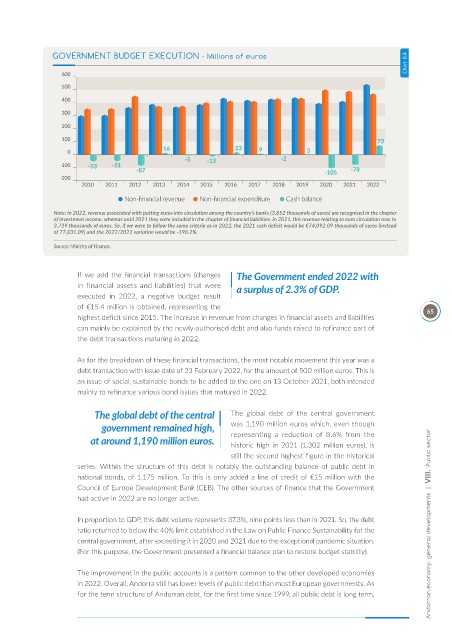
GOVERNMENT BUDGET EXECUTION - Millions of euros
                                                                                                            Chart  8.4


                                  Non-financial revenue  Non-financial expenditure  Cash balance
               Note: In 2022, revenue associated with putting euros into circulation among the country’s banks (3,852 thousands of euros) are recognised in the chapter
               of investment income, whereas until 2021 they were included in the chapter of financial liabilities. In 2021, this revenue relating to euro circulation rose to
               3,739 thousands of euros. So, if we were to follow the same criteria as in 2022, the 2021 cash deficit would be €74,092.09 thousands of euros (instead
               of 77,831.09) and the 2022/2021 variation would be -198.2%.
               Source: Ministry of Finance.


                     If  we  add  the  financial  transactions  (changes   The Government ended 2022 with
                     in financial assets and liabilities) that were   a surplus of 2.3% of GDP.
                     executed  in  2022,  a  negative  budget  result
                     of €15.4 million is obtained, representing the                                              65
                     highest deficit since 2015. The increase in revenue from changes in financial assets and liabilities
                     can mainly be explained by the newly-authorised debt and also funds raised to refinance part of
                     the debt transactions maturing in 2022.

                     As for the breakdown of these financial transactions, the most notable movement this year was a
                     debt transaction with issue date of 23 February 2022, for the amount of 500 million euros. This is
                     an issue of social, sustainable bonds to be added to the one on 13 October 2021, both intended
                     mainly to refinance various bond issues that matured in 2022.

                          The global debt of the central      The  global  debt  of  the  central  government
                            government remained high,         was 1,190 million euros which, even though
                         at around 1,190 million euros.       representing  a  reduction  of  8.6%  from  the
                                                              historic  high  in  2021  (1,302  million  euros),  is
                                                              still the second highest figure in the historical
                     series. Within the structure of this debt is notably the outstanding balance of public  debt in
                     national bonds, of 1,175 million. To this is only added a line of credit of €15 million with the
                     Council of Europe Development Bank (CEB). The other sources of finance that the Government
                     had active in 2022 are no longer active.


                     In proportion to GDP, this debt volume represents 37.3%, nine points less than in 2021. So, the debt   Andorran economy: general developments  |  VIII.  Public sector
                     ratio returned to below the 40% limit established in the Law on Public Finance Sustainability for the
                     central government, after exceeding it in 2020 and 2021 due to the exceptional pandemic situation.
                     (For this purpose, the Government presented a financial balance plan to restore budget stability).

                     The improvement in the public accounts is a pattern common to the other developed economies
                     in 2022. Overall, Andorra still has lower levels of public debt than most European governments. As
                     for the term structure of Andorran debt, for the first time since 1999, all public debt is long term,

