


Page 68 - Economic report 2020
P. 68
contrasting with the situation in the period 2017-2021, when it represented 68% on average,
                     compared with 32% short-term debt. In this context, the International Monetary Fund (IMF) has
                     supported the fiscal discipline process which has enabled Andorra to reduce public debt and meet
                     the fiscal targets set for 2022.


                 1.1.   Revenue


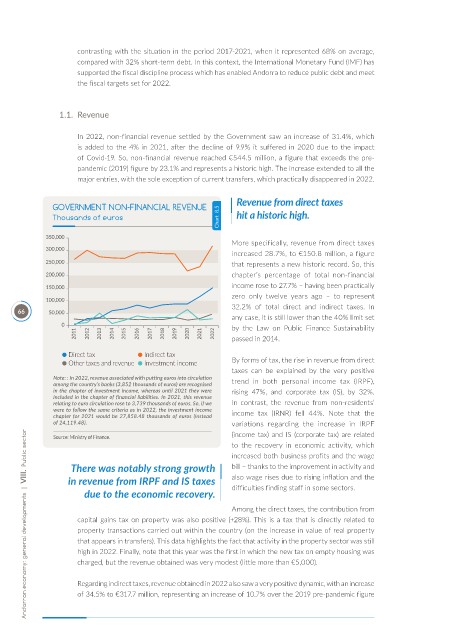
                     In 2022, non-financial revenue settled by the Government saw an increase of 31.4%, which
                     is added to the 4% in 2021, after the decline of 9.9% it suffered in 2020 due to the impact
                     of Covid-19. So, non-financial revenue reached €544.5 million, a figure that exceeds the pre-
                     pandemic (2019) figure by 23.1% and represents a historic high. The increase extended to all the
                     major entries, with the sole exception of current transfers, which practically disappeared in 2022.

                                                               Revenue from direct taxes
               GOVERNMENT NON-FINANCIAL REVENUE
               Thousands of euros                          Chart  8.5   hit a historic high.


                                                              More specifically, revenue from direct taxes
                                                              increased 28.7%, to €150.8 million, a figure
                                                              that represents a new historic record. So, this
                                                              chapter’s  percentage  of  total  non-financial
                                                              income rose to 27.7% – having been practically
                                                              zero  only  twelve  years  ago  –  to  represent
                                                              32.2%  of  total  direct  and  indirect  taxes.  In
      66
                                                              any case, it is still lower than the 40% limit set
                                                              by  the  Law  on  Public  Finance  Sustainability
                                                              passed in 2014.

                   Direct tax          Indirect tax
                   Other taxes and revenue  Investment income  By forms of tax, the rise in revenue from direct
                                                              taxes  can  be  explained  by  the  very  positive
               Note: : In 2022, revenue associated with putting euros into circulation   trend  in  both  personal  income  tax  (IRPF),
               among the country’s banks (3,852 thousands of euros) are recognised
               in the chapter of investment income, whereas until 2021 they were   rising  47%,  and  corporate  tax  (IS),  by  32%.
               included in the chapter of financial liabilities. In 2021, this revenue
               relating to euro circulation rose to 3,739 thousands of euros. So, if we   In  contrast,  the  revenue  from  non-residents’
               were to follow the same criteria as in 2022, the investment income   income  tax  (IRNR)  fell  44%.  Note  that  the
               chapter for 2021 would be 27,858.48 thousands of euros (instead
               of 24,119.48).                                 variations  regarding  the  increase  in  IRPF
        Andorran economy: general developments  |  VIII.  Public sector
               Source: Ministry of Finance.                   (income  tax)  and  IS  (corporate  tax)  are  related
                                                              to the recovery in economic activity, which
                                                              increased both business profits and the wage
                    There was notably strong growth           bill – thanks to the improvement in activity and
                   in revenue from IRPF and IS taxes          also wage rises due to rising inflation and the
                       due to the economic recovery.          difficulties finding staff in some sectors.

                                                              Among the direct taxes, the contribution from
                     capital gains tax on property was also positive (+28%). This is a tax that is directly related to
                     property transactions carried out within the country (on the increase in value of real property
                     that appears in transfers). This data highlights the fact that activity in the property sector was still
                     high in 2022. Finally, note that this year was the first in which the new tax on empty housing was
                     charged, but the revenue obtained was very modest (little more than €5,000).

                     Regarding indirect taxes, revenue obtained in 2022 also saw a very positive dynamic, with an increase
                     of 34.5% to €317.7 million, representing an increase of 10.7% over the 2019 pre-pandemic figure

