


Page 71 - Economic report 2020
P. 71
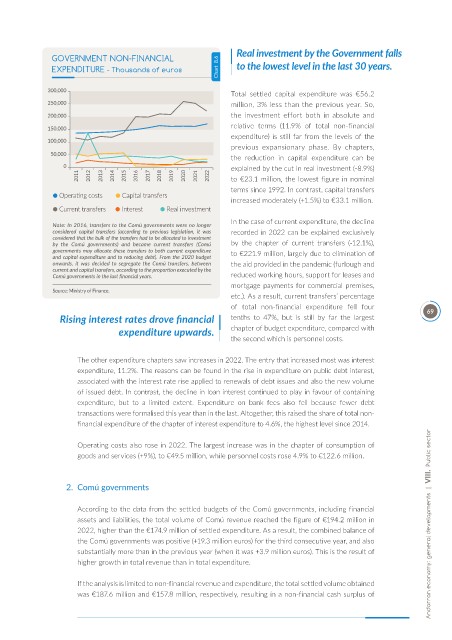
Real investment by the Government falls
               GOVERNMENT NON-FINANCIAL
               EXPENDITURE - Thousands of euros           Chart  8.6     to the lowest level in the last 30 years.


                                                              Total  settled  capital  expenditure  was  €56.2
                                                              million, 3% less than the previous year. So,
                                                              the  investment  effort  both  in  absolute  and
                                                              relative  terms  (11.9%  of  total  non-financial
                                                              expenditure) is still far from the levels of the
                                                              previous  expansionary  phase.  By  chapters,
                                                              the  reduction  in  capital  expenditure  can  be
                                                              explained by the cut in real investment (-8.9%)
                                                              to €23.1 million, the lowest figure in nominal
                                                              terms since 1992. In contrast, capital transfers
                 Operating costs  Capital transfers
                                                              increased moderately (+1.5%) to €33.1 million.
                 Current transfers  Interest  Real investment
                                                              In the case of current expenditure, the decline
               Note: In 2016, transfers to the Comú governments were no longer
               considered  capital  transfers  (according  to  previous  legislation,  it  was   recorded in 2022 can be explained exclusively
               considered that the bulk of the transfers had to be allocated to investment
               by  the  Comú  governments)  and  became  current  transfers  (Comú   by  the  chapter  of  current  transfers  (-12.1%),
               governments may allocate these transfers to both current expenditure   to €221.9 million, largely due to elimination of
               and capital expenditure and to reducing debt). From the 2020 budget
               onwards,  it was  decided  to  segregate  the  Comú  transfers,  between   the aid provided in the pandemic (furlough and
               current and capital transfers, according to the proportion executed by the
               Comú governments in the last financial years.  reduced working hours, support for leases and
                                                              mortgage payments for commercial premises,
               Source: Ministry of Finance.
                                                              etc.). As a result, current transfers’ percentage
                                                              of  total  non-financial  expenditure  fell  four   69
                 Rising interest rates drove financial        tenths  to  47%,  but  is  still  by  far  the  largest
                                expenditure upwards.          chapter of budget expenditure, compared with
                                                              the second which is personnel costs.

                     The other expenditure chapters saw increases in 2022. The entry that increased most was interest
                     expenditure, 11.2%. The reasons can be found in the rise in expenditure on public debt interest,
                     associated with the interest rate rise applied to renewals of debt issues and also the new volume
                     of issued debt. In contrast, the decline in loan interest continued to play in favour of containing
                     expenditure,  but  to  a  limited  extent.  Expenditure  on  bank  fees  also  fell  because  fewer  debt
                     transactions were formalised this year than in the last. Altogether, this raised the share of total non-
                     financial expenditure of the chapter of interest expenditure to 4.6%, the highest level since 2014.

                     Operating costs also rose in 2022. The largest increase was in the chapter of consumption of
                     goods and services (+9%), to €49.5 million, while personnel costs rose 4.9% to €122.6 million.


                  2.   Comú governments


                     According to the data from the settled budgets of the Comú governments, including financial
                     assets and liabilities, the total volume of Comú revenue reached the figure of €194.2 million in   Andorran economy: general developments  |  VIII.  Public sector
                     2022, higher than the €174.9 million of settled expenditure. As a result, the combined balance of
                     the Comú governments was positive (+19.3 million euros) for the third consecutive year, and also
                     substantially more than in the previous year (when it was +3.9 million euros). This is the result of
                     higher growth in total revenue than in total expenditure.

                     If the analysis is limited to non-financial revenue and expenditure, the total settled volume obtained
                     was €187.6 million and €157.8 million, respectively, resulting in a non-financial cash surplus of

