


Page 31 - Economic report 2020
P. 31
Andorran economy:


                     general developments


              IV.      Population, labour market and education


                  1.  Population and migratory flows

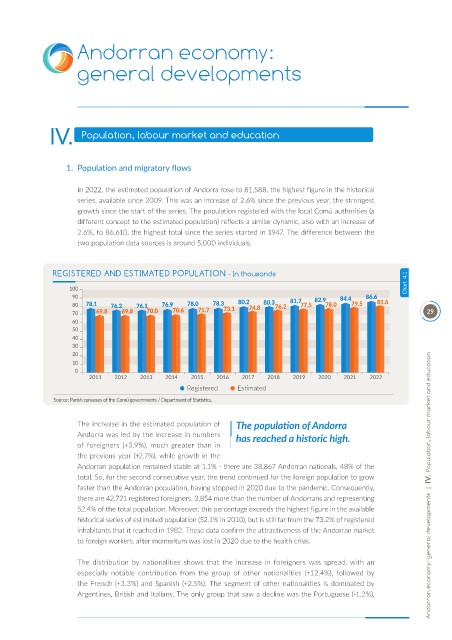
                     In 2022, the estimated population of Andorra rose to 81,588, the highest figure in the historical
                     series, available since 2009. This was an increase of 2.6% since the previous year, the strongest
                     growth since the start of the series. The population registered with the local Comú authorities (a
                     different concept to the estimated population) reflects a similar dynamic, also with an increase of
                     2.6%, to 86,610, the highest total since the series started in 1947. The difference between the
                     two population data sources is around 5,000 individuals.


               REGISTERED AND ESTIMATED POPULATION - In thousands
                                                                                                            Chart  4.1


                                                                                                                 29


                                                  Registered    Estimated
               Source: Parish censuses of the Comú governments / Department of Statistics.


                     The increase in the estimated population of   The population of Andorra
                     Andorra was led by the increase in numbers   has reached a historic high.
                     of  foreigners  (+3.9%),  much  greater  than  in
                     the previous year (+2.7%), while growth in the
                     Andorran population remained stable at 1.1% - there are 38,867 Andorran nationals, 48% of the
                     total. So, for the second consecutive year, the trend continued for the foreign population to grow
                     faster than the Andorran population, having stopped in 2020 due to the pandemic. Consequently,   Andorran economy: general developments  |  IV.  Population, labour market and education
                     there are 42,721 registered foreigners, 3,854 more than the number of Andorrans and representing
                     52.4% of the total population. Moreover, this percentage exceeds the highest figure in the available
                     historical series of estimated population (52.1% in 2010), but is still far from the 73.2% of registered
                     inhabitants that it reached in 1982. These data confirm the attractiveness of the Andorran market
                     to foreign workers, after momentum was lost in 2020 due to the health crisis.


                     The  distribution  by  nationalities  shows  that  the  increase  in  foreigners  was  spread,  with  an
                     especially  notable  contribution  from  the  group  of  other  nationalities  (+12.4%),  followed  by
                     the French (+3.3%) and Spanish (+2.5%). The segment of other nationalities is dominated by
                     Argentines, British and Italians. The only group that saw a decline was the Portuguese (-1.2%),

