


Page 27 - Economic report 2020
P. 27
Private consumption and investment            the previous year. So, household consumption
                                    grow at high rates.       grew  4.5%  in  2022  and,  despite  being  lower
                                                              than GDP growth (+5.5%), the importance of
                                                              this  component  (representing  56%  of  GDP)
                     meant that its contribution to GDP growth was 2.4 percentage points (practically half of the
                     growth in the Spanish economy that year). In contrast, the trend in consumption by the public
                     authorities was negative in 2022 (-0.7%), due to the major increase in public spending in the
                     pandemic  years,  much  of  which  has  been  reversed.  Nevertheless,  important  measures  were
                     adopted in 2022 to offset the impact of rising energy and food prices on the most affected
                     groups, for example the subsidy of €0.2/litre on fuel; the VAT reduction on the electricity bill, and
                     direct aid to the most affected sectors. Moreover, a new line of credit was established, of 10,000
                     million euros (0.6% of GDP) for vulnerable businesses.

                     Investment also saw a very positive trend in 2022, with growth of 3.5%, although this was lower
                     than the 5.9% recorded in the previous year. This dynamic is a clear sign of economic confidence
                     and reflects the revival of a large number of the investment projects that were halted during
                     the pandemic. Moreover, implementation of the NextGenerationEU funds represented additional
                     resources, although the multiplier effect on private investment this year was still low.


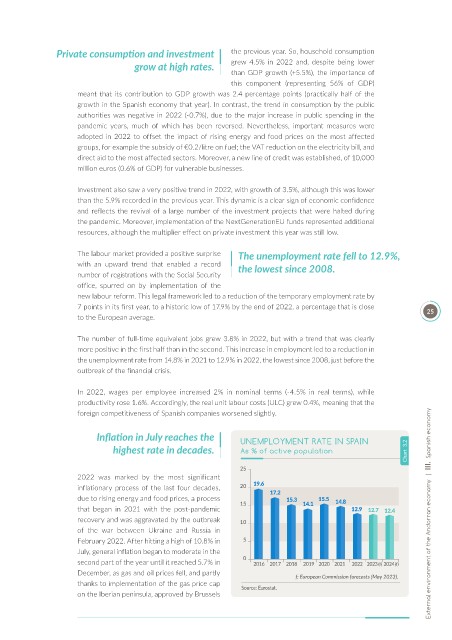
                     The labour market provided a positive surprise   The unemployment rate fell to 12.9%,
                     with  an  upward  trend  that  enabled  a  record   the lowest since 2008.
                     number of registrations with the Social Security
                     office,  spurred  on  by  implementation  of  the
                     new labour reform. This legal framework led to a reduction of the temporary employment rate by
                     7 points in its first year, to a historic low of 17.9% by the end of 2022, a percentage that is close   25
                     to the European average.


                     The number of full-time equivalent jobs grew 3.8% in 2022, but with a trend that was clearly
                     more positive in the first half than in the second. This increase in employment led to a reduction in
                     the unemployment rate from 14.8% in 2021 to 12.9% in 2022, the lowest since 2008, just before the
                     outbreak of the financial crisis.


                     In  2022,  wages  per  employee  increased  2%  in  nominal  terms  (-4.5%  in  real  terms),  while
                     productivity rose 1.6%. Accordingly, the real unit labour costs (ULC) grew 0.4%, meaning that the
                     foreign competitiveness of Spanish companies worsened slightly.


                          Inflation in July reaches the         UNEMPLOYMENT RATE IN SPAIN
                               highest rate in decades.         As % of active population                   Chart  3.2


                     2022  was  marked  by  the  most  significant
                     inflationary process of the last four decades,
                     due to rising energy and food prices, a process
                     that  began  in  2021  with  the  post-pandemic                                              External environment of the Andorran economy  |  III.  Spanish economy
                     recovery and was aggravated by the outbreak
                     of  the  war  between  Ukraine  and  Russia  in
                     February 2022. After hitting a high of 10.8% in
                     July, general inflation began to moderate in the
                     second part of the year until it reached 5.7% in
                     December, as gas and oil prices fell, and partly          f: European Commission forecasts (May 2023).
                     thanks to implementation of the gas price cap   Source: Eurostat.
                     on the Iberian peninsula, approved by Brussels

