


Page 28 - Economic report 2020
P. 28
(“Iberian  exception”).  At  the  same  time,
               SPAIN'S PUBLIC DEFICIT*                        underlying  inflation  (excluding  unprocessed
               As % of GDP                                 Chart  3.3  food and energy products) crept up, as costs

                                                              were  transferred  to  end  prices  in  the  other
                                                              products  in  the  basket  of  consumer  goods,
                                                              reaching  7%  in  December.  For  now,  there
                                                              appears to be no risk of a wage-price spiral, as
                                                              wage increases are fairly contained, although
                                                              this is affecting household consumption, as
                                                              they see their purchasing power reduced.


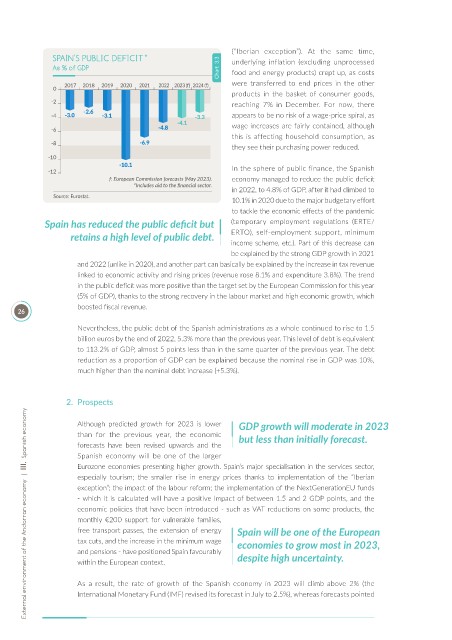
                                                              In the sphere of public finance, the Spanish
                              f: European Commission forecasts (May 2023).  economy managed to reduce the public deficit
                                    *Includes aid to the financial sector.
                                                              in 2022, to 4.8% of GDP, after it had climbed to
               Source: Eurostat.
                                                              10.1% in 2020 due to the major budgetary effort
                                                              to tackle the economic effects of the pandemic
             Spain has reduced the public deficit but         (temporary  employment  regulations  (ERTE/
                    retains a high level of public debt.      ERTO), self-employment support, minimum
                                                              income scheme, etc.). Part of this decrease can
                                                              be explained by the strong GDP growth in 2021
                     and 2022 (unlike in 2020), and another part can basically be explained by the increase in tax revenue
                     linked to economic activity and rising prices (revenue rose 8.1% and expenditure 3.8%). The trend
                     in the public deficit was more positive than the target set by the European Commission for this year
                     (5% of GDP), thanks to the strong recovery in the labour market and high economic growth, which
                     boosted fiscal revenue.
      26
                     Nevertheless, the public debt of the Spanish administrations as a whole continued to rise to 1.5
                     billion euros by the end of 2022, 5.3% more than the previous year. This level of debt is equivalent
                     to 113.2% of GDP, almost 5 points less than in the same quarter of the previous year. The debt
                     reduction as a proportion of GDP can be explained because the nominal rise in GDP was 10%,
                     much higher than the nominal debt increase (+5.3%).


                  2.  Prospects
        External environment of the Andorran economy  |  III.  Spanish economy
                     Although  predicted  growth  for  2023  is  lower   GDP growth will moderate in 2023
                     than  for  the  previous  year,  the  economic   but less than initially forecast.
                     forecasts  have  been  revised  upwards  and  the
                     Spanish economy will be one of the larger
                     Eurozone economies presenting higher growth. Spain’s major specialisation in the services sector,
                     especially  tourism;  the  smaller  rise  in  energy  prices  thanks  to  implementation  of  the  “Iberian
                     exception”; the impact of the labour reform; the implementation of the NextGenerationEU funds
                     - which it is calculated will have a positive impact of between 1.5 and 2 GDP points, and the
                     economic policies that have been introduced - such as VAT reductions on some products, the
                     monthly €200 support for vulnerable families,
                     free transport passes, the extension of energy   Spain will be one of the European
                     tax cuts, and the increase in the minimum wage   economies to grow most in 2023,
                     and pensions - have positioned Spain favourably
                     within the European context.               despite high uncertainty.

                     As  a  result,  the  rate  of  growth  of  the  Spanish  economy  in  2023  will  climb  above  2%  (the
                     International Monetary Fund (IMF) revised its forecast in July to 2.5%), whereas forecasts pointed

