


Page 26 - Economic report 2020
P. 26
due to the impact of inflation and rising interest rates, from a year-on-year variation rate of 6.9%
                     in the first quarter to 2.6% in the fourth.


                     The economic recovery impacted all economic sectors but at a different intensity. Services played
                     a major role in the economic revival due to their relatively high importance (67% of GDP) and
                     the major rebound seen in 2022 (+6.5%). Within services, the subsectors that saw the strongest
                                                              growth were commerce, transport and hotels
                Services linked to tourism and leisure        and catering, which increased 16.5% year on
                lead growth in the Spanish economy.           year in 2022 (and 15.6% in 2021, after falling
                                                              25.5%  in  2020),  and  artistic  and  recreational
                                                              activities  (+13.8%).  In  contrast,  gross  value
                     added  (GVA)  shrank  5.7%  in  financial  activities;  1.4%  in  activities  linked  to  public  services
                     (administration, health, education and social services), and 1.1% in agriculture. Industry, affected
                     by  the  supply  crisis,  showed  positive  behaviour  (+3%)  but  weaker  than  in  overall  GDP,  and
                     construction rebounded to 4.1% due to the reactivation of demand, despite rising building costs.


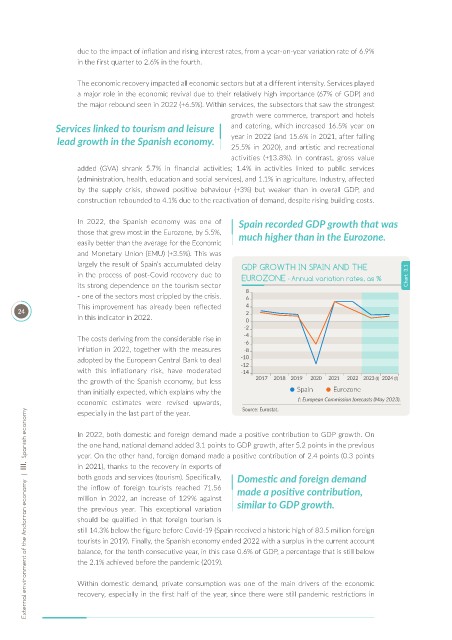
                     In  2022,  the  Spanish  economy  was  one  of   Spain recorded GDP growth that was
                     those that grew most in the Eurozone, by 5.5%,   much higher than in the Eurozone.
                     easily better than the average for the Economic
                     and Monetary Union (EMU) (+3.5%). This was
                     largely the result of Spain’s accumulated delay   GDP GROWTH IN SPAIN AND THE
                     in the process of post-Covid recovery due to   EUROZONE - Annual variation rates, as %  Chart  3.1
                     its strong dependence on the tourism sector
                     - one of the sectors most crippled by the crisis.
                     This improvement has already been reflected
      24
                     in this indicator in 2022.

                     The costs deriving from the considerable rise in
                     inflation in 2022, together with the measures
                     adopted by the European Central Bank to deal
                     with  this  inflationary  risk,  have  moderated
                     the growth of the Spanish economy, but less
                     than initially expected, which explains why the           Spain     Eurozone
                     economic  estimates  were  revised  upwards,               f: European Commission forecasts (May 2023).
        External environment of the Andorran economy  |  III.  Spanish economy
                     especially in the last part of the year.    Source: Eurostat.

                     In 2022, both domestic and foreign demand made a positive contribution to GDP growth. On
                     the one hand, national demand added 3.1 points to GDP growth, after 5.2 points in the previous
                     year. On the other hand, foreign demand made a positive contribution of 2.4 points (0.3 points
                     in 2021), thanks to the recovery in exports of
                     both goods and services (tourism). Specifically,   Domestic and foreign demand
                     the  inflow  of  foreign  tourists  reached  71.56   made a positive contribution,
                     million  in  2022,  an  increase  of  129%  against
                     the  previous  year.  This  exceptional  variation   similar to GDP growth.
                     should  be  qualified  in  that  foreign  tourism  is
                     still 14.3% below the figure before Covid-19 (Spain received a historic high of 83.5 million foreign
                     tourists in 2019). Finally, the Spanish economy ended 2022 with a surplus in the current account
                     balance, for the tenth consecutive year, in this case 0.6% of GDP, a percentage that is still below
                     the 2.1% achieved before the pandemic (2019).

                     Within  domestic  demand,  private  consumption  was  one  of  the  main  drivers  of  the  economic
                     recovery, especially in the first half of the year, since there were still pandemic restrictions in

