


Page 55 - Economic report 2020
P. 55
and investment, which easily exceeds the value   The trade deficit reaches
                     of Andorran exports. In 2022, the trade deficit   a historic high.
                     hit €1,405.6 million, 19% higher than in the
                     previous year. If we exclude the chapter of
                     works of art and antiques, this figure rises to €1,601.7 million. In both cases, the highest level of
                     trade deficit in the historical series was reached in 2022.


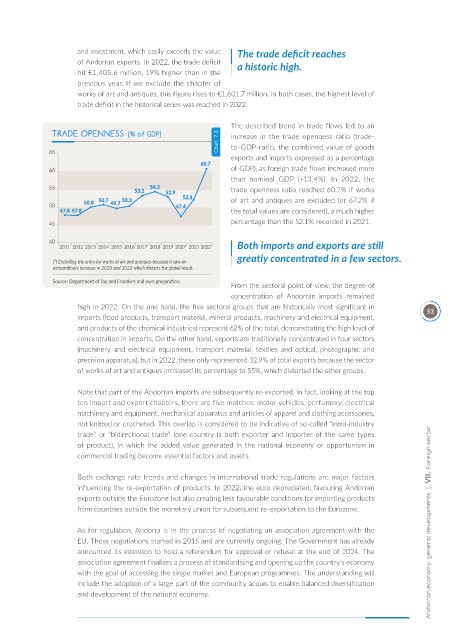
                                                              The described trend in trade flows led to an
                                                          Chart  7.3   to-GDP-ratio, the combined value of goods
               TRADE OPENNESS (% of GDP)                      increase  in  the  trade  openness  ratio  (trade-

                                                              exports and imports expressed as a percentage
                                                              of GDP), as foreign trade flows increased more
                                                              than  nominal  GDP  (+13.4%).  In  2022,  the
                                                              trade openness ratio reached 60.7% if works
                                                              of art and antiques are excluded (or 67.2% if
                                                              the total values are considered), a much higher
                                                              percentage than the 52.1% recorded in 2021.

                                                                Both imports and exports are still
                                                                greatly concentrated in a few sectors.
               (*) Excluding the entry for works of art and antiques because it saw an
               extraordinary increase in 2020 and 2022 which distorts the global result.

               Source: Department of Tax and Frontiers and own preparation.
                                                              From the sectoral point of view, the degree of
                                                              concentration  of  Andorran  imports  remained
                     high in 2022. On the one hand, the five sectoral groups that are historically most significant in   53
                     imports (food products, transport material, mineral products, machinery and electrical equipment,
                     and products of the chemical industries) represent 62% of the total, demonstrating the high level of
                     concentration in imports. On the other hand, exports are traditionally concentrated in four sectors
                     (machinery  and  electrical  equipment,  transport  material,  textiles  and  optical,  photographic  and
                     precision apparatus), but in 2022, these only represented 32.9% of total exports because the sector
                     of works of art and antiques increased its percentage to 55%, which distorted the other groups.


                     Note that part of the Andorran imports are subsequently re-exported. In fact, looking at the top
                     ten import and export chapters, there are five matches: motor vehicles, perfumery, electrical
                     machinery and equipment, mechanical apparatus and articles of apparel and clothing accessories,
                     not knitted or crocheted. This overlap is considered to be indicative of so-called “intra-industry
                     trade”  or  “bidirectional  trade”  (one  country  is  both  exporter  and  importer  of  the  same  types
                     of  product),  in  which  the  added  value  generated  in  the  national  economy  or  opportunism  in
                     commercial trading become essential factors and assets.


                     Both exchange rate trends and changes in international trade regulations are major factors
                     influencing the re-exportation of products. In 2022, the euro depreciated, favouring Andorran
                     exports outside the Eurozone but also creating less favourable conditions for importing products
                     from countries outside the monetary union for subsequent re-exportation to the Eurozone.

                     As for regulation, Andorra is in the process of negotiating an association agreement with the   Andorran economy: general developments  |  VII.  Foreign sector
                     EU. These negotiations started in 2015 and are currently ongoing. The Government has already
                     announced its intention to hold a referendum for approval or refusal at the end of 2024. The
                     association agreement finalises a process of standardising and opening up the country’s economy
                     with the goal of accessing the single market and European programmes. The understanding will
                     include the adoption of a large part of the community acquis to enable balanced diversification
                     and development of the national economy.

