


Page 53 - Economic report 2020
P. 53
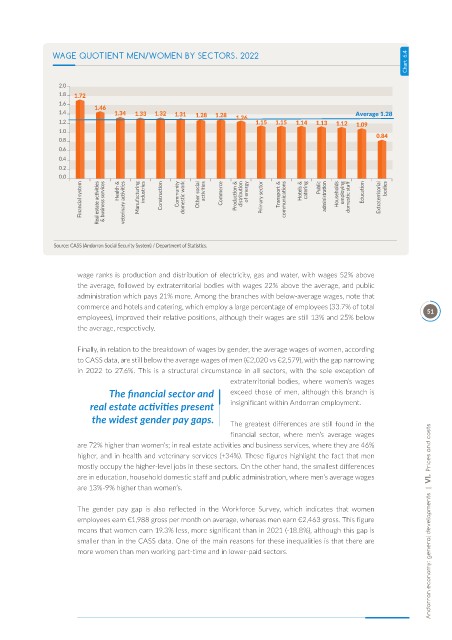
Chart  6.4
               WAGE QUOTIENT MEN/WOMEN BY SECTORS. 2022


               Source: CASS (Andorran Social Security System) / Department of Statistics.


                     wage ranks is production and distribution of electricity, gas and water, with wages 52% above
                     the average, followed by extraterritorial bodies with wages 22% above the average, and public
                     administration which pays 21% more. Among the branches with below-average wages, note that
                     commerce and hotels and catering, which employ a large percentage of employees (33.7% of total   51
                     employees), improved their relative positions, although their wages are still 13% and 25% below
                     the average, respectively.


                     Finally, in relation to the breakdown of wages by gender, the average wages of women, according
                     to CASS data, are still below the average wages of men (€2,020 vs €2,579), with the gap narrowing
                     in  2022  to  27.6%.  This  is  a  structural  circumstance  in  all  sectors,  with  the  sole  exception  of
                                                              extraterritorial  bodies,  where  women’s  wages
                              The financial sector and        exceed those of men, although this branch is
                         real estate activities present       insignificant within Andorran employment.
                         the widest gender pay gaps.          The greatest differences are still found in the

                                                              financial  sector,  where  men’s  average  wages
                     are 72% higher than women’s; in real estate activities and business services, where they are 46%
                     higher, and in health and veterinary services (+34%). These figures highlight the fact that men
                     mostly occupy the higher-level jobs in these sectors. On the other hand, the smallest differences
                     are in education, household domestic staff and public administration, where men’s average wages
                     are 13%-9% higher than women’s.


                     The  gender  pay  gap  is  also  reflected  in  the  Workforce  Survey,  which  indicates  that  women
                     employees earn €1,988 gross per month on average, whereas men earn €2,463 gross. This figure   Andorran economy: general developments  |  VI.  Prices and costs
                     means that women earn 19.3% less, more significant than in 2021 (-18.8%), although this gap is
                     smaller than in the CASS data. One of the main reasons for these inequalities is that there are
                     more women than men working part-time and in lower-paid sectors.

