


Page 50 - Economic report 2020
P. 50
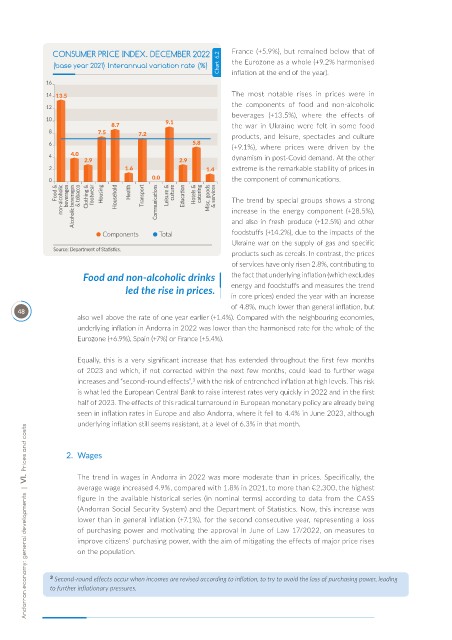
CONSUMER PRICE INDEX. DECEMBER 2022            France (+5.9%), but remained below that of
               (base year 2021) Interannual variation rate (%)  Chart  6.2     the Eurozone as a whole (+9.2% harmonised
                                                              inflation at the end of the year).


                                                              The  most  notable  rises  in  prices  were  in
                                                              the  components  of  food  and  non-alcoholic
                                                              beverages  (+13.5%),  where  the  effects  of
                                                              the war in Ukraine were felt in some food
                                                              products,  and  leisure,  spectacles  and  culture
                                                              (+9.1%),  where  prices  were  driven  by  the
                                                              dynamism in post-Covid demand. At the other
                                                              extreme is the remarkable stability of prices in
                                                              the component of communications.

                                                              The trend by special groups shows a strong
                                                              increase in the energy component (+28.5%),
                                                              and  also  in  fresh  produce  (+12.5%)  and  other
                            Components     Total              foodstuffs (+14.2%), due to the impacts of the
                                                              Ukraine war on the supply of gas and specific
               Source: Department of Statistics.
                                                              products such as cereals. In contrast, the prices
                                                              of services have only risen 2.8%, contributing to
                       Food and non-alcoholic drinks          the fact that underlying inflation (which excludes
                                  led the rise in prices.     energy and foodstuffs and measures the trend
                                                              in core prices) ended the year with an increase
                                                              of 4.8%, much lower than general inflation, but
      48
                     also well above the rate of one year earlier (+1.4%). Compared with the neighbouring economies,
                     underlying inflation in Andorra in 2022 was lower than the harmonised rate for the whole of the
                     Eurozone (+6.9%), Spain (+7%) or France (+5.4%).

                     Equally, this is a very significant increase that has extended throughout the first few months
                     of 2023 and which, if not corrected within the next few months, could lead to further wage
                     increases and “second-round effects”,  with the risk of entrenched inflation at high levels. This risk
                                                    3
                     is what led the European Central Bank to raise interest rates very quickly in 2022 and in the first
                     half of 2023. The effects of this radical turnaround in European monetary policy are already being
                     seen in inflation rates in Europe and also Andorra, where it fell to 4.4% in June 2023, although
                     underlying inflation still seems resistant, at a level of 6.3% in that month.
        Andorran economy: general developments  |  VI.  Prices and costs


                  2. Wages


                     The trend in wages in Andorra in 2022 was more moderate than in prices. Specifically, the
                     average wage increased 4.9%, compared with 1.8% in 2021, to more than €2,300, the highest
                     figure in the available historical series (in nominal terms) according to data from the CASS
                     (Andorran Social Security System) and the Department of Statistics. Now, this increase was
                     lower than in general inflation (+7.1%), for the second consecutive year, representing a loss
                     of purchasing power and motivating the approval in June of Law 17/2022, on measures to
                     improve citizens’ purchasing power, with the aim of mitigating the effects of major price rises
                     on the population.


              3  Second-round effects occur when incomes are revised according to inflation, to try to avoid the loss of purchasing power, leading
              to further inflationary pressures.

