


Page 52 - Economic report 2020
P. 52
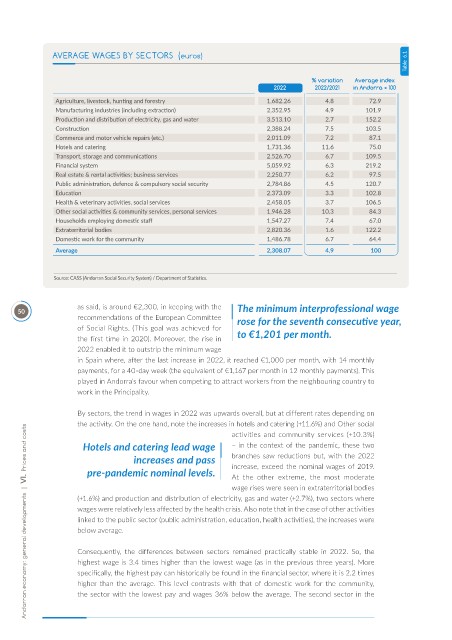
Table  6.1
               AVERAGE WAGES BY SECTORS  (euros)


                                                                                   % variation  Average index
                                                                         2022       2022/2021  in Andorra = 100
                Agriculture, livestock, hunting and forestry           1,682.26        4.8        72.9
                Manufacturing industries (including extraction)        2,352.95        4.9       101.9
                Production and distribution of electricity, gas and water  3,513.10    2.7       152.2
                Construction                                           2,388.24        7.5       103.5
                Commerce and motor vehicle repairs (etc.)              2,011.09        7.2        87.1
                Hotels and catering                                    1,731.36       11.6        75.0
                Transport, storage and communications                  2,526.70        6.7       109.5
                Financial system                                       5,059.92        6.3       219.2
                Real estate & rental activities; business services     2,250.77        6.2        97.5
                Public administration, defence & compulsory social security  2,784.86  4.5       120.7
                Education                                              2,373.09        3.3       102.8
                Health & veterinary activities, social services        2,458.05        3.7       106.5
                Other social activities & community services, personal services  1,946.28  10.3   84.3
                Households employing domestic staff                    1,547.27        7.4        67.0
                Extraterritorial bodies                                2,820.36        1.6       122.2
                Domestic work for the community                        1,486.78        6.7        64.4
                Average                                                2,308.07        4.9         100


               Source: CASS (Andorran Social Security System) / Department of Statistics.


                     as said, is around €2,300, in keeping with the   The minimum interprofessional wage
      50
                     recommendations of the European Committee   rose for the seventh consecutive year,
                     of Social Rights. (This goal was achieved for   to €1,201 per month.
                     the  first  time  in  2020).  Moreover,  the  rise  in
                     2022 enabled it to outstrip the minimum wage
                     in Spain where, after the last increase in 2022, it reached €1,000 per month, with 14 monthly
                     payments, for a 40-day week (the equivalent of €1,167 per month in 12 monthly payments). This
                     played in Andorra’s favour when competing to attract workers from the neighbouring country to
                     work in the Principality.

                     By sectors, the trend in wages in 2022 was upwards overall, but at different rates depending on
                     the activity. On the one hand, note the increases in hotels and catering (+11.6%) and Other social
        Andorran economy: general developments  |  VI.  Prices and costs
                                                              activities and community services (+10.3%)
                       Hotels and catering lead wage          – in the context of the pandemic, these two
                                    increases and pass        branches saw reductions but, with the 2022
                        pre-pandemic nominal levels.          increase, exceed the nominal wages of 2019.
                                                              At  the  other  extreme,  the  most  moderate
                                                              wage rises were seen in extraterritorial bodies
                     (+1.6%) and production and distribution of electricity, gas and water (+2.7%), two sectors where
                     wages were relatively less affected by the health crisis. Also note that in the case of other activities
                     linked to the public sector (public administration, education, health activities), the increases were
                     below average.


                     Consequently,  the  differences  between  sectors  remained  practically  stable  in  2022.  So,  the
                     highest wage is 3.4 times higher than the lowest wage (as in the previous three years). More
                     specifically, the highest pay can historically be found in the financial sector, where it is 2.2 times
                     higher  than  the  average.  This  level  contrasts  with  that  of  domestic  work  for  the  community,
                     the sector with the lowest pay and wages 36% below the average. The second sector in the

