


Page 51 - Economic report 2020
P. 51
Box 6.1
                  LAW 17/2022, OF 9 JUNE, ON MEASURES TO IMPROVE CITIZENS’ PURCHASING POWER


                 This Law proposes establishing certain measures within     Modification of the indirect tax rate applied to
                 the financial and social fields to help improve citizens’   certain products relating to feminine hygiene and
                 purchasing power. Among the measures are notably:  baby care, so they come under the reduced tax rate.


                    Obliging businesses to raise, by at least 3.3%, wages     Regarding energy self-consumption, elimination of
                   that are below €27,130.44 per year and which have   the limitation on producing electricity at the source
                   not been raised by this percentage in the last twelve   of consumption. So, the Government is authorised
                   months  and  are  not  new  employment  contracts   to  pass  regulations  to  develop  the  figure  of
                   signed in the last twelve months.             producer-consumer, the permitted territorial scope
                                                                 of self-consumption and the necessary aspects for
                    A  3.67%  increase  to  contributory  retirement   effective implementation of the measure.
                   pensions, widows’ pensions and disability allowances
                   deriving from a non-occupational accident or     Postponement of compliance with the obligation
                   common illness, and disability allowances deriving   to file annual accounts with the Accounts Registry
                   from  an  occupational  accident  or  professional   until the financial year starting in January 2023,
                   illness from 1 June 2022, for those who receive a   to temporarily ease the legal requirements for
                   monthly pension/allowance that is below the CASS   businesses  other  than  joint  stock  or  limited
                   interprofessional  minimum  wage,  and  who  can   companies that have an annual income of less than
                   show a minimum contribution period of 25 years.  €150,000.

                                                                                                                 49


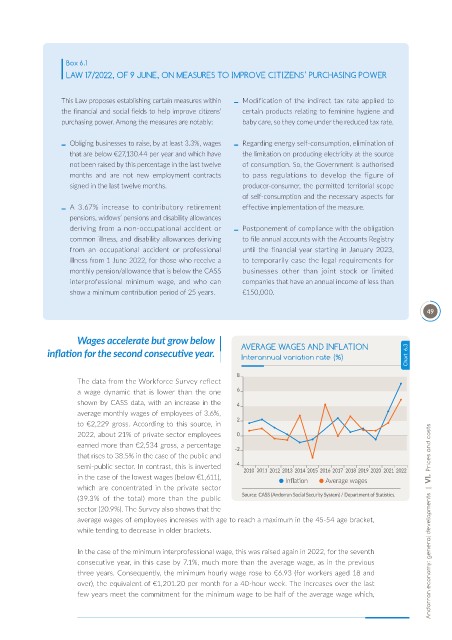
                     Wages accelerate but grow below
              inflation for the second consecutive year.         AVERAGE WAGES AND INFLATION                Chart  6.3
                                                                 Interannual variation rate (%)


                     The data from the Workforce Survey reflect
                     a  wage  dynamic  that  is  lower  than  the  one
                     shown  by  CASS  data,  with  an  increase  in  the
                     average monthly wages of employees of 3.6%,
                     to  €2,229  gross.  According  to  this  source,  in
                     2022, about 21% of private sector employees
                     earned more than €2,534 gross, a percentage
                     that rises to 38.5% in the case of the public and
                     semi-public sector. In contrast, this is inverted
                     in the case of the lowest wages (below €1,611),        Inflation  Average wages
                     which  are  concentrated  in  the  private  sector
                     (39.3%  of  the  total)  more  than  the  public   Source: CASS (Andorran Social Security System) / Department of Statistics.
                     sector (20.9%). The Survey also shows that the
                     average wages of employees increases with age to reach a maximum in the 45-54 age bracket,   Andorran economy: general developments  |  VI.  Prices and costs
                     while tending to decrease in older brackets.


                     In the case of the minimum interprofessional wage, this was raised again in 2022, for the seventh
                     consecutive year, in this case by 7.1%, much more than the average wage, as in the previous
                     three years. Consequently, the minimum hourly wage rose to €6.93 (for workers aged 18 and
                     over), the equivalent of €1,201.20 per month for a 40-hour week. The increases over the last
                     few years meet the commitment for the minimum wage to be half of the average wage which,

