


Page 22 - Economic report 2020
P. 22
with milder-than-usual temperatures in winter, helped the French economy to remain resilient
                     in the last months of 2022. Note that, as well as the production of coke and products distilled
                     from oil, which was affected by the strikes in October, production in the manufacturing branches
                     shrank only moderately, despite a significant fall in energy consumption by businesses in the
                     sector.  Households  also  showed  positive  consumption  behaviour  thanks  to  the  good  labour
                     market dynamics, the measures taken to sustain purchasing power and the savings accumulated
                     during the pandemic.


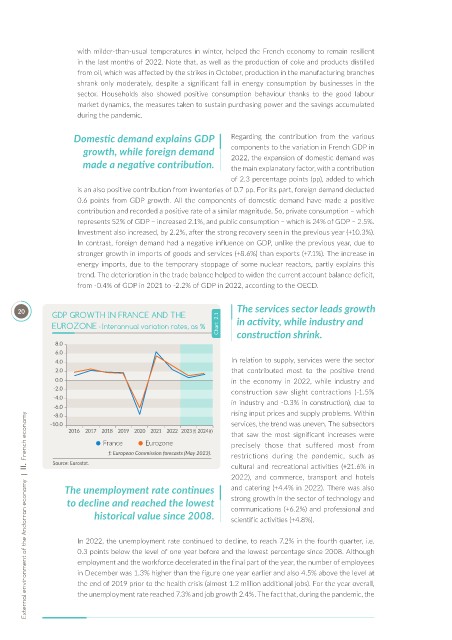
                    Domestic demand explains GDP              Regarding  the  contribution  from  the  various
                       growth, while foreign demand           components to the variation in French GDP in
                       made a negative contribution.          2022, the expansion of domestic demand was
                                                              the main explanatory factor, with a contribution
                                                              of 2.3 percentage points (pp), added to which
                     is an also positive contribution from inventories of 0.7 pp. For its part, foreign demand deducted
                     0.6 points from GDP growth. All the components of domestic demand have made a positive
                     contribution and recorded a positive rate of a similar magnitude. So, private consumption – which
                     represents 52% of GDP – increased 2.1%, and public consumption – which is 24% of GDP – 2.5%.
                     Investment also increased, by 2.2%, after the strong recovery seen in the previous year (+10.3%).
                     In contrast, foreign demand had a negative influence on GDP, unlike the previous year, due to
                     stronger growth in imports of goods and services (+8.6%) than exports (+7.1%). The increase in
                     energy imports, due to the temporary stoppage of some nuclear reactors, partly explains this
                     trend. The deterioration in the trade balance helped to widen the current account balance deficit,
                     from -0.4% of GDP in 2021 to -2.2% of GDP in 2022, according to the OECD.


                                                               The services sector leads growth
      20       GDP GROWTH IN FRANCE AND THE
               EUROZONE - Interannual variation rates, as %  Chart  2.1  in activity, while industry and
                                                               construction shrink.


                                                              In relation to supply, services were the sector
                                                              that  contributed  most  to  the  positive  trend
                                                              in  the  economy  in  2022,  while  industry  and
                                                              construction  saw  slight  contractions  (-1.5%
                                                              in industry and -0.3% in construction), due to
                                                              rising input prices and supply problems. Within
        External environment of the Andorran economy  |  II.  French economy
                                                              services, the trend was uneven. The subsectors
                                                              that  saw  the  most  significant  increases  were
                            France     Eurozone               precisely  those  that  suffered  most  from
                              f: European Commission forecasts (May 2023).  restrictions  during  the  pandemic,  such  as
               Source: Eurostat.                              cultural  and  recreational  activities  (+21.6%  in
                                                              2022),  and  commerce,  transport  and  hotels
                  The unemployment rate continues             and catering (+4.4% in 2022). There was also
                   to decline and reached the lowest          strong growth in the sector of technology and

                          historical value since 2008.        communications (+6.2%) and professional and
                                                              scientific activities (+4.8%).

                     In 2022, the unemployment rate continued to decline, to reach 7.2% in the fourth quarter, i.e.
                     0.3 points below the level of one year before and the lowest percentage since 2008. Although
                     employment and the workforce decelerated in the final part of the year, the number of employees
                     in December was 1.3% higher than the figure one year earlier and also 4.5% above the level at
                     the end of 2019 prior to the health crisis (almost 1.2 million additional jobs). For the year overall,
                     the unemployment rate reached 7.3% and job growth 2.4%. The fact that, during the pandemic, the

