


Page 24 - Economic report 2020
P. 24
The  public  deficit  reached  124,900  million   The public deficit shrank after
                     euros in 2022, representing 4.7% of GDP, after   the extraordinary increase due
                     hitting  9.0%  of  GDP  in  2020.  As  for  public
                     revenue, which represents 53.4% of GDP, this   to the pandemic.
                     remained  very  dynamic  (+7.3%  in  2022  and
                     +8.4% in 2021), thanks to the recovery of the French economy after Covid-19, and rising prices,
                     which increase the bases (wages and business profits) of the main types of tax. As for public
                     expenditure, which represents 58.1% of GDP, this rose to a similar rate to the previous year (+4%)
                     mainly due to the increase in debt interest payments; increased remuneration of public employees,
                     and the measures passed to help the groups most affected by rising inflation. Regarding the debt
                     of the public administrations, according to the Maastricht definition, this fell slightly from 112.9%
                     of GDP in 2021 to 111.6% in 2022.


                  2.  Prospects


                     One and a half years after the outbreak of war in Ukraine, and three and a half years after the first
                     lockdown, one could say that western economies, including France, have resisted these shocks
                     better than expected, but still run the risk of high inflation. However, not all countries are exposed
                     to such challenges to the same extent. Within the Eurozone, France is probably less jeopardised
                     than the countries that depended more on Russian gas before the war, so its economic prospects
                     for 2023 and 2024 are somewhat more positive than those of other countries like Germany or
                     the United Kingdom.


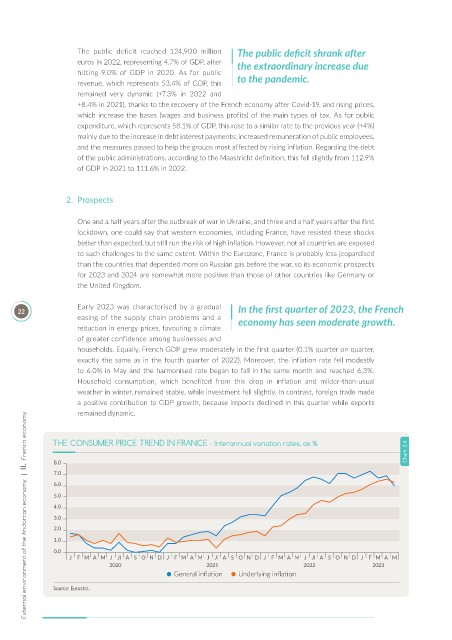
                     Early 2023 was characterised by a gradual   In the first quarter of 2023, the French
      22
                     easing of the supply chain problems and a   economy has seen moderate growth.
                     reduction in energy prices, favouring a climate
                     of greater confidence among businesses and
                     households. Equally, French GDP grew moderately in the first quarter (0.1% quarter on quarter,
                     exactly the same as in the fourth quarter of 2022). Moreover, the inflation rate fell modestly
                     to 6.0% in May and the harmonised rate began to fall in the same month and reached 6.3%.
                     Household  consumption,  which  benefited  from  this  drop  in  inflation  and  milder-than-usual
                     weather in winter, remained stable, while investment fell slightly. In contrast, foreign trade made
                     a positive contribution to GDP growth, because imports declined in this quarter while exports
                     remained dynamic.
        External environment of the Andorran economy  |  II.  French economy


                                                                                                            Chart  2.4
               THE CONSUMER PRICE TREND IN FRANCE - Interannual variation rates, as %


                                               General inflation  Underlying inflation
               Source: Eurostat.

