


Page 23 - Economic report 2020
P. 23
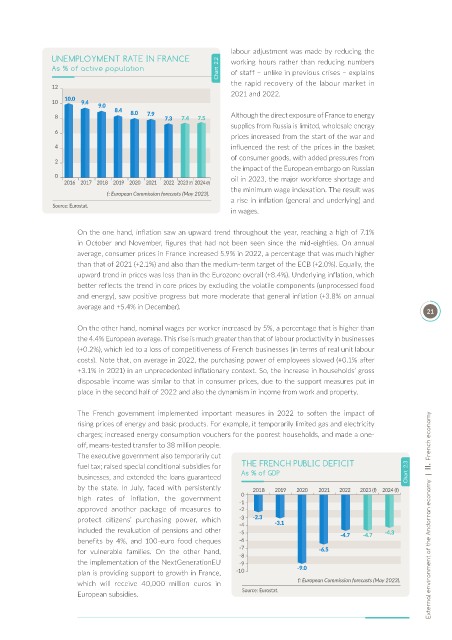
labour adjustment was made by reducing the
               UNEMPLOYMENT RATE IN FRANCE                    working  hours  rather  than  reducing  numbers
               As % of active population                  Chart  2.2   of staff – unlike in previous crises – explains

                                                              the rapid recovery of the labour market in
                                                              2021 and 2022.

                                                              Although the direct exposure of France to energy
                                                              supplies from Russia is limited, wholesale energy
                                                              prices increased from the start of the war and
                                                              influenced the rest of the prices in the basket
                                                              of consumer goods, with added pressures from
                                                              the impact of the European embargo on Russian
                                                              oil in 2023, the major workforce shortage and
                                                              the minimum wage indexation. The result was
                             f: European Commission forecasts (May 2023).
                                                              a rise in inflation (general and underlying) and
               Source: Eurostat.
                                                              in wages.

                     On the one hand, inflation saw an upward trend throughout the year, reaching a high of 7.1%
                     in October and November, figures that had not been seen since the mid-eighties. On annual
                     average, consumer prices in France increased 5.9% in 2022, a percentage that was much higher
                     than that of 2021 (+2.1%) and also than the medium-term target of the ECB (+2.0%). Equally, the
                     upward trend in prices was less than in the Eurozone overall (+8.4%). Underlying inflation, which
                     better reflects the trend in core prices by excluding the volatile components (unprocessed food
                     and energy), saw positive progress but more moderate that general inflation (+3.8% on annual
                     average and +5.4% in December).
                                                                                                                 21
                     On the other hand, nominal wages per worker increased by 5%, a percentage that is higher than
                     the 4.4% European average. This rise is much greater than that of labour productivity in businesses
                     (+0.2%), which led to a loss of competitiveness of French businesses (in terms of real unit labour
                     costs). Note that, on average in 2022, the purchasing power of employees slowed (+0.1% after
                     +3.1% in 2021) in an unprecedented inflationary context. So, the increase in households’ gross
                     disposable income was similar to that in consumer prices, due to the support measures put in
                     place in the second half of 2022 and also the dynamism in income from work and property.

                     The  French  government  implemented  important  measures  in  2022  to  soften  the  impact  of
                     rising prices of energy and basic products. For example, it temporarily limited gas and electricity
                     charges; increased energy consumption vouchers for the poorest households, and made a one-
                     off, means-tested transfer to 38 million people.
                     The executive government also temporarily cut
                     fuel tax; raised special conditional subsidies for   THE FRENCH PUBLIC DEFICIT
                     businesses, and extended the loans guaranteed   As % of GDP                            Chart  2.3
                     by  the  state.  In  July,  faced  with  persistently
                     high  rates  of  inflation,  the  government
                     approved  another  package  of  measures  to
                     protect  citizens’  purchasing  power,  which                                                External environment of the Andorran economy  |  II.  French economy
                     included the revaluation of pensions and other
                     benefits  by  4%,  and  100-euro  food  cheques
                     for  vulnerable  families.  On  the  other  hand,
                     the implementation of the NextGenerationEU
                     plan is providing support to growth in France,
                     which  will  receive  40,000  million  euros  in          f: European Commission forecasts (May 2023).
                     European subsidies.                         Source: Eurostat.

